By Dr. Stéphane Mbiankeu Nguea
Highlights
- Cameroon’s annual rice demand stands at 648,000 tonnes, yet local supply barely reaches 270,000 tonnes—nowhere near the 750,000-tonne target set for 2030. The state spends 162.5 billion CFA francs each year importing rice, compared to 385 billion allocated to domestic production over six years.
- Burkina Faso, with half the GDP and harsher conditions, has just suspended rice imports after a million-tonne harvest in 2025, fully covering national needs and doubling local demand since 2016.
- Cameroon possesses fertile plains, a large farming population, and trained agronomists, but structural neglect of production basins and a policy bias toward imports keeps the country dependent on foreign food aid.
- A practical path exists: condition import licences on investment in local production, open up farming areas through infrastructure, and regulate markets to protect both farmers and low-income households.
Introduction
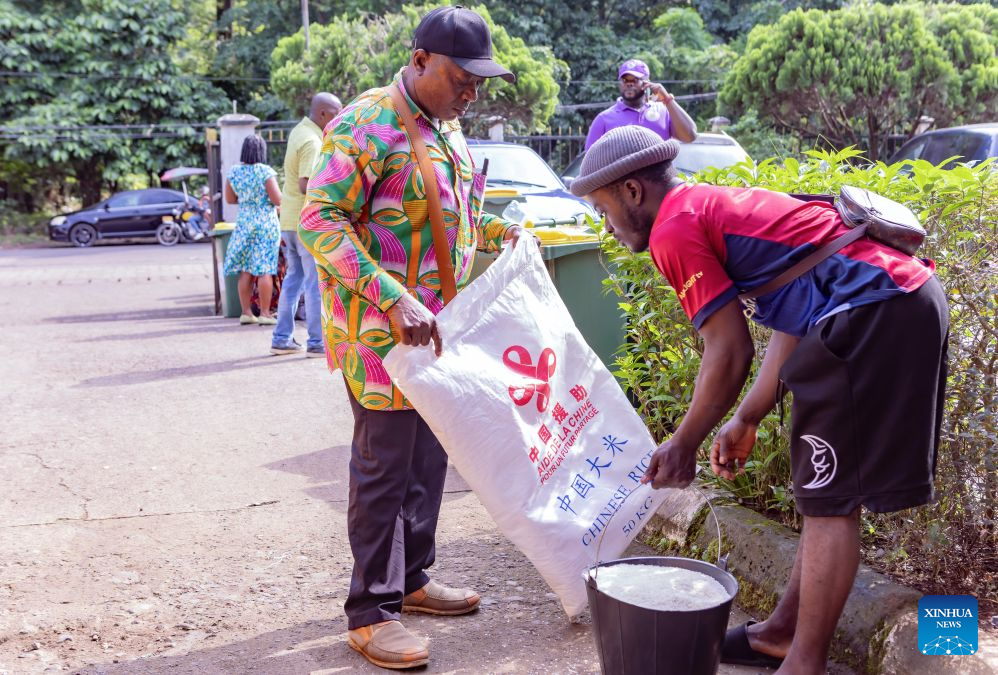
The port of Douala was delivered of 880 tonnes of wheat and 1,630 tonnes of rice, a food donation from the People’s Republic of China valued at 1.6 billion CFA francs. No one questions the goodwill behind such assistance. However, the gesture forces an uncomfortable question into the open: how can Cameroon, blessed with vast fertile land, a large farming population, and agronomists trained in reputable institutions, still depend on foreign food aid to feed its people? National rice demand stands at roughly 648,000 tonnes per year. Local supply struggles to reach 270, 000 tonnes, a long way from the 750,000-tonne target set by the National Rice Development Strategy for 2030. More troubling still is the structure of public spending. The government disburses approximately 162. 5 billion CFA francs in 2022 on rice imports, compared with 385 billion allocated to domestic rice production over a six-year period. Put simply, we spend nearly half the six-year production budget each year just bringing in rice from Asia. Budget allocations often provide useful insight into policy priorities. None of this is a matter of climatic or geographical inevitability. The proof comes from a Sahelian country known for its aridity, and an economy half the size of Cameroon.
The Burkina Faso Model
The Burkinabe government has taken a decisive step by suspending rice imports to allow national production to flow to market. The decision can be viewed as a protective trade measure, but it was also designed to support domestic producers and strengthen food security. In addition, pragmatic, grounded in tangible results. During the 2025 season, Burkina Faso recorded a harvest of one million tonnes of rice, achieving satisfactory coverage of national needs. Local demand, at just 350,000 tonnes in 2016, nearly doubled to 600,000 tonnes by 2023—clear evidence that supply can drive consumption when the product is available and competitively priced. This policy yields three positive outcomes. It structures a domestic value chain that generates lasting agricultural employment. It eases pressure on foreign currency reserves, no small matter at a time when the CFA franc’s regional monetary environment faces transformation. In addition, it strengthens the country’s food sovereignty—a concept too rarely translated into operational decisions. While Burkina Faso’s experience reflects important progress, sustaining self-sufficiency will require continued investment in productivity, infrastructure, and market access.
A Call for Radical Change
Cameroon can draw useful lessons from other countries to chart a path suited to its own circumstances. A first measure would link rice import licences to mandatory investment commitments in local production. The principle is straightforward: any importer should demonstrate proportional engagement in the national rice sector, whether through contracts with producer cooperatives, financing for processing facilities, or participation in seed research programmes. Such commitments could be measured through investments in production, processing, storage infrastructure, or support to producer cooperatives.
A second priority concerns opening up production basins. The rice plains of Ndop, the Logone Valley, and the Noun region hold enormous potential; yet getting harvests to market remains an obstacle course. Impassable roads, high transport costs, and a lack of structured collection points all take their toll. Every kilometre shaved off these constraints makes a tonne of local rice more competitive against imported alternatives.
The third task involves market regulation. Protecting local production must not penalise the poorest households. A price monitoring mechanism combined with targeted subsidies can reconcile the goal of developing the domestic sector with the imperative of food access for all. Transparent supply chains and modernised wholesale markets are the technical prerequisites for solving this equation.
Over the years, the rice sector has been crowded with overlapping initiatives: donor-funded projects, parastatal agencies, decentralised programmes, each with its own timeline and reporting line. Despite the number of programmes operating in the sector, farmers often struggle to see tangible improvements in access to inputs, extension services, or guaranteed markets. Inputs arrive late, extension advice is sporadic, and promised purchase agreements evaporate. If Cameroon is thoughtful about producing more rice, it needs a single, accountable rice development authority with the mandate to coordinate policy, manage strategic stocks, and report results to parliament. Without simplification of governance, additional funding will continue to disappear into the administrative machinery.
There is a generational dimension to this as well. Rural youth are leaving the land, while see their parents toil for uncertain returns and understandably look to cities or migration as an escape. Without attractive economic opportunities in agriculture, rural youth will continue to migrate toward urban centres where employment opportunities are already limited. Yet a modern rice value chain could offer exactly what they need: not just work, but decent work—in mechanised production, quality control, milling, packaging, and logistics. Burkina Faso has made strides by supporting youth-led cooperatives and linking them to structured markets. Cameroon, with its larger economy and deeper agricultural tradition, can do even better, but only if youth employment is embedded in agricultural policy rather than treated as a separate social programme.
Conclusion
Chinese food assistance is welcome, and it meets a genuine short-term need. However, it cannot substitute for agricultural policy. Cameroon possesses every asset required to feed its own population and even export to the sub-region. What has been missing is not land, not water, not talent. It is sustained coherence between the objectives laid out in national strategies and the budgets actually adopted by parliament, between the agencies that plan and the farmers who produce. Burkina Faso, with half the population and a smaller economy, has shown that political will can shift the balance. The question is no longer whether Cameroon has the potential to achieve rice self-sufficiency. The question is whether it is willing to align public investment, market incentives and agricultural policy around that objective.