By Dr Stéphane Mbiankeu Nguea
Highlights
Urban pressure: The city’s footprint has fivefold in 40 years. Forest cover dropped from 28% to 5%. Yaoundé is drowning in concrete.
Social Crisis: High costs push families to the outskirts. Long commutes break family ties. Parents are becoming strangers to their own children.
Policy Urgency: The State should enforce strict zoning and vertical social housing. We shoud build “the city within the city” to bring services back to the people.
Introduction
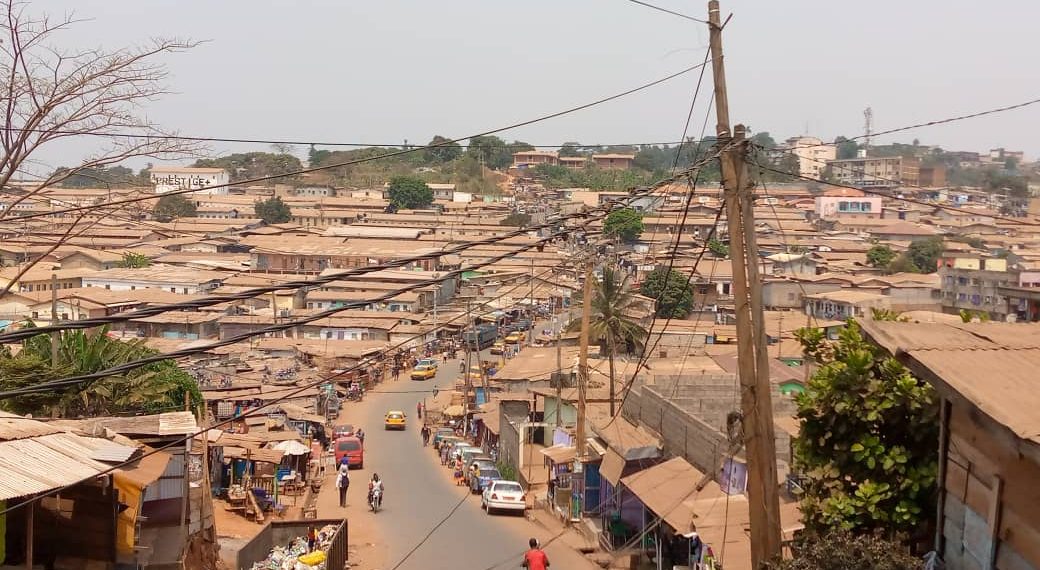
Yaoundé is struggling to keep up with its own growth. This is no longer a metaphor. It is a physical and statistical reality that threatens the very viability of the political capital. According to world population review, the population of the “city of seven hills” surged from 75,500 to over 4.9 million, maintaining a staggering annual growth rate of 4.5% between 1960 and 2025. However, the true challenge lies not in the numbers but in the form of this growth: the city has literally exploded spatially. From a footprint of 84.67 Km2 in 1984, it now sprawls across 468.28 Km2 in 2024. In forty years, the development has reduced forest cover from 28.60% to a remnant of 5.40%.
The Drivers of Crisis: Rural Exodus and Land Exclusion
Two forces drive this spatial disorder. On one side, a massive rural exodus that the city absorbs without prior infrastructure. On the other, a central real estate market that has become so prohibitive it flings families and young professionals toward increasingly distant outskirts—from Soa to Nomayos, Afanoyoa to Awae. This sprawl is not a lifestyle choice; it is a sentence to economic isolation. By settling on the periphery to access property, populations are chained to grueling commutes. Yaoundé’s traffic jams are merely the visible symptom of a poorly designed city where millions of productivity hours are lost daily. Crucially, this distance causes a profound breakdown of family ties: parents leaving before dawn and returning in the night become strangers to their own children. Our social cohesion is eroding under the weight of distance.
- The Infrastructure Gap: A Losing Race
Current urban sprawl creates logistical challenges for the State. As the city spreads horizontally, the “linear cost” of infrastructure becomes excessive. To serve a single isolated house 25 km from the centre, the Ministry of Water and Energy (MINEE) must lay kilometres of networks where, in a dense city, a few meters would suffice. The result is concerning. The State, faces with this dispersion, struggles to bring basic services to the people. New neighbourhoods grow without public schools, referral hospitals, or sanitation networks. This deficiency turns these areas into institutional deserts where waterborne diseases find fertile ground. Sprawl is thus a multiplier of social vulnerabilities.
Choosing Trajectories: Lagos’s Chaos vs. Kigali’s Discipline
To understand the emergency, let us compare two African trajectories. In the West, Lagos allowed informal sprawl and “laissez-faire” land management to take over: today, 70% of its residents live in unserviced areas. In contrast, Kigali imposed a binding land-use plan, coupled with strict zoning and vertical housing programs. Consequently, the Rwandan capital tripled its density in ten years without losing economic attractiveness. While these cities differ significantly in history, governance, and economic structure, they illustrate how planning choices can influence urban development trajectories. Yaoundé stands at a crossroads between these two models. Unlike Lagos, where the absence of land authority benefited informal developers, Yaoundé can still choose the path of strong leadership. However, this requires the Ministry of Housing and Urban Development (MINHDU) and the Yaoundé City Council (CUY) to jointly enforce protected zoning.
Toward Iron-Clad Planning: Adapting Rigorous Models
Faced with this emergency, the “laissez-faire” approach to land management is an administrative failure. It is time for Cameroon to draw inspiration from the rigor of planning policies seen in major metropolises in the World, adapting them to our institutional realities. We must move from “reactive” to “prescriptive” urbanism through three levers.
Mandatory and Protected Zoning
Drawing inspiration from international experiences in land preservation and urban planning as seen in China, the Cameroonian State should designate and protect three distinct zones by law:
- Protected Zoning: A formal ban on building on fertile peri-urban land. These areas must remain the city’s food basket to combat food insecurity.
- Strategic Industrial Zones: To prevent factories from being encircled by informal housing.
- High-Density Residential Zones: Where the State prioritizes its infrastructure investment.
The Vertical City: High-Capacity Social Housing
Sprawl is the result of “individual villas” that consume too much land. We should break this paradigm and encourage high density in the city centre. The State should invest massively in high-capacity social housing complexes—modern residential towers—offering affordable rents. Living vertically in the centre saves land for nature, reduces transport needs, and allows the State to get a return on every meter of water pipe or electric cable laid.
Public Transport as the Backbone
Urban development should follow rails or Bus Rapid Transit (BRT) lanes, not the other way around. Investment should shift away from “car-centric” models toward high-performance mass transit. This will break the isolation of peripheral neighborhoods and reduce the city’s carbon footprint.
Conclusion: Building the City Within the City
Restoring State authority over land use is no longer a technical option; it is a necessity for national survival. To save Yaoundé, let us stop destroying the forest to build exclusion: it is time to build the city within the city