
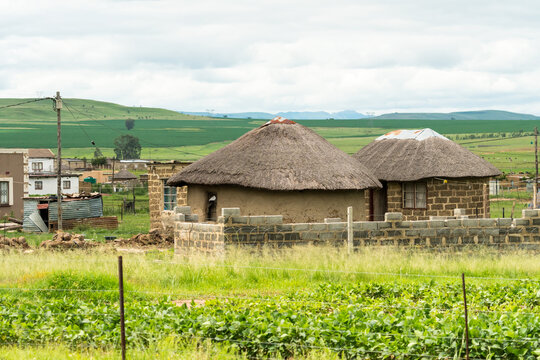
Village associations, also known as meetings, and bonds of solidarity connecting rural to urban areas (and vice versa), may provide a vital key to managing development funds. This observation is against a backdrop of public projects that are either mismanaged or unexecuted, making them look fraudulent [1]. Village meetings and bonds of rural-urban linkages are interesting cultural phenomena formed by people to serve the interest of the village. They provide platforms for collective decision-making, with the village being at the core. This essay argues that development projects in Cameroon may be more effective if the villages control funds from the state and other donors.
Development Projects and Funds in Cameroon
Whistle blowers and activists working to expose corruption and mismanagement in Cameroon routinely post photos and videos of poorly executed projects on social media. They post non-existent and terribly executed construction projects such as roads, schools, hospitals, market stalls, etc. Within the past couple of years, many newspapers are writing about abandoned, cancelled, and standstill development projects [2, 3 ], with some of them urging the government to take punitive action against fraudulent contractors [3]. In certain circumstances, the government has resorted to threatening contractors or terminating delayed or abandoned contracts [4, 5].
That notwithstanding, it is crucial to ask why contractors fail to honour their contracts. An answer to this question has much to do with the power of the contractors. For sure, the contractors get away because the people affected by the development project do not have enough power to influence politicians responsible for disbursing investment funds. Additionally, the community concerned may not know where to channel their complaint when contractors fail to do their jobs (properly). They lack power, that is, the ability to influence outcomes. Communities may be powerless when dealing with contractors who have strong connections to the central power structure. It may not even be clear how contractors got the contract to execute projects in the first place. In this scenario, contractors may always get off the hook as long as communities cannot hold them responsible. However, there could be situations where communities have overriding power over contractors or those handling development funds. Studies on village meetings and rural-urban connections partly provide insight to this claim.
Village Initiatives, Development projects, and Funding
To improve accountability, and perhaps to democratize funding, the government and donors could deal with villages directly. This approach will be consistent with the grassroots approach of implementing development projects. They may, for example deliver the funds to the villagers who in turn look for contractors to execute the project. This suggestion sounds simplistic until we begin to unpack the details of how it may work. To make the point clearer, I am going to draw examples from centralized societies such as the Cameroon Grassfields. With the king (Fon or Fo) and palace as the central authority, these societies have evolved socioeconomic and political structures that can efficiently handle development funds, with people’s strong allegiance to the village being a key rallying point.
In relation to village development, the Grassfields have undergone three main transformations within the past century, all related to migration and displacements, which have in turn made the village a point of focus [6]. Rural-urban linkages, associational life, and the social media provide platforms to rally indigenes of the different Grassfields villagers residing out of the kingdom. They consider village development as their responsibility, and this is where prudent management of development funds becomes a crucial matter.
The media is important in this development process. Presently, social media is providing platforms for easy and fast communication, mobilizing indigenes for development projects, and potentially linking villagers to donors (and government funding departments). It further provides villagers with the opportunity to monitor financial contributions and to document work on projects. My research reveals that most Grassfields villages have WhatsApp groups that rally their indigenes the world over, and top on their agenda are strategies to develop the village. As such, they contribute money (and make a list of contributors) for projects such as road maintenance, rural solar electrification, construction of classrooms, etc. This open online process encourages transparency and accountability [7]. There is also the question of selecting contractors for village projects. Villagers, united through associations and rural-urban connections, may be more able to select and sanction fraudulent contractors, some of whom belong to the village meetings.
Sources of Village Power: Exploring Meetings and Rural-Urban Linkages
Vibrant village social media platforms rest on strong and deep-rooted village associations that connect indigenes of the village worldwide. Village associations are a formidable force; villagers of various socioeconomic standing, including the king, submit to this overarching rallying point. Before examining the source of power of the village, it would be informative to provide a brief history of the village meetings and rural-urban linkages. What really are village meetings and rural-urban connections?
Anthropologists studying associational life and rural-urban linkages in the Cameroon Grassfields attribute these developments to migration within the past century. Even as they migrated to the coastal plantations and urban areas, people from the Grassfields continue to keep ties with their kith and kin back in the villages in the hinterlands. This aside, for over a century, the migrants from the hinterlands areas of western Grassfields (villages in what we generally call Bamenda) and eastern Grassfields (villages in the Bamileke area), have formed village meetings wherever they live. The meetings have morphed into village development organizations, with branches found in different towns in Cameroon and beyond [8]. (Other non-Grassfields villages have copied this practice). Membership of these meetings means the individual willingly or reluctantly, submits to the demands, moralities, responsibilities, and perceived benefits of togetherness. So strong are the associations that even villagers who are well established in the urban areas (and abroad) still express loyalty to the rural home community by belonging to the meetings [6].
Certainly, such loyalty to the village can be a formidable force behind the management of village development funds. The likelihood of villagers embezzling village development funds can be minimized when they are personally responsible for the village’s progress, but more especially, when they fear being ostracized. Village meetings and rural-urban connections function as social control mechanisms that sanction villagers who fail to comply with expectations set by these institutions. For sure, there are questions and challenges such as expertise to award the contracts, selecting people who oversee the bidding of contracts, and corruption.
One must admit that these connections and bonds of solidarity are not perfect. They nevertheless provide an ideal space for the government to work directly with the people affected by development projects. Villagers would unlikely choose a miscreant contractor. They may decide to select contractors from within the village or from outside, but the key point here is that they are the ones involved in the selection process. Offering a contract to members of the village (with expertise in the needed domain) could be one of the easiest decisions because they know the contractors, their families, and their socioeconomic standing.
In this scenario, it is highly possible that they cannot award contracts to villagers who are not contributing to the development of the village. An individual migrant stays connected to the village primarily through the village meeting in town or abroad. Opting out of the meeting, and thus, not contributing to village development may come with dire consequences. For example, a deceased may be denied a burial spot in the village. In his article on mortuary rites and identity politics in postcolonial Cameroon, Nantang Jua observes that corpses ‘take on value’ and that the place of burial is crucial in identity construction and loyalty [9]. He reports instances where traditional authorities in the Grassfields refuse to provide burial grounds for migrant citizens who did not contribute to the development of their village.
Conclusion
The supposition in this piece is that villagers could better manage development funds thanks to existing social control mechanisms and bonds of solidarity that consider the village as paramount. Villagers can more easily sanction members who misappropriate development funds. In the era of the internet, social media platforms such as WhatsApp help villagers to gather village development funds, share information, and to monitor people responsible for executing village development projects. Thus, the meetings and the rural-urban links continue to evolve, responding to the modern times as demonstrated in the village WhatsApp group, which has become a sort of community hall where people express their opinion. Conclusively, village meetings, rural-urban connections, and social media, potentially provide villagers a democratic platform to manage development funds in their area.

Dr. Primus M. Tazanu
Dr Primus M. Tazanu is a Research Fellow in Governance at the Nkafu Policy Institute .He is equally a lecturer at the Department of Sociology and Anthropology, University of Buea, Cameroon. Primus holds a PhD in social anthropology from the University of Freiburg, Germany