Context
Cameroon is governed by a de facto autocratic regime, guised by some democratic tenets like elections and multipartism [1]. Despite the presence of multipartism, the country’s judicial, executive, legislative, and entire political landscape is dominated by the leading political party Cameroon People’s Democratic Movement (CPDM), taking advantage of state institutions to crack down opposition parties, possess and control absolute powers, manipulate elections, and suppress civil society. According to reports from both local and international election stakeholders, Cameroon’s elections are flawed by rife anomalies, including election rigging; suppression of voters, stuffing of ballot boxes, intimidation of voters, journalists, and opposition candidates and representatives, and no transparent vote counting [2]. The lack of independence by the elections management body – Elections Cameroon (ELECAM) further reinforces scepticism about the credibility of elections in Cameroon. Cameroon’s blemished electoral process has negatively affected the peace and security of the country. Grievances amongst many marginalised groups were orchestrated by the lack of real political competition, especially in the English-speaking regions, where demands for political representation have intensified over time and become a conflict of separation to create an independent state [3]. Moreover, the absence of democratic accountability has enabled corruption, poor governance, and retarded economic development which accounts for the aggravated socio-political instabilities. This paper aims to analyse how electoral autocracy in Cameroon threatens the peace and security of the state, and further suggest the way forward to restoring the credibility of democratic institutions to resolve conflict and restore peace.
- Overview of Cameroon’s electoral process
The electoral system in Cameroon is defined by laws enshrined in the Electoral Code (Law No. 2012/001 of April 19, 2012, as amended in 2019) [4]. It is crucial to understand the electoral system through this systematic overview before considering the risks posed by Cameroon’s electoral autocracy.
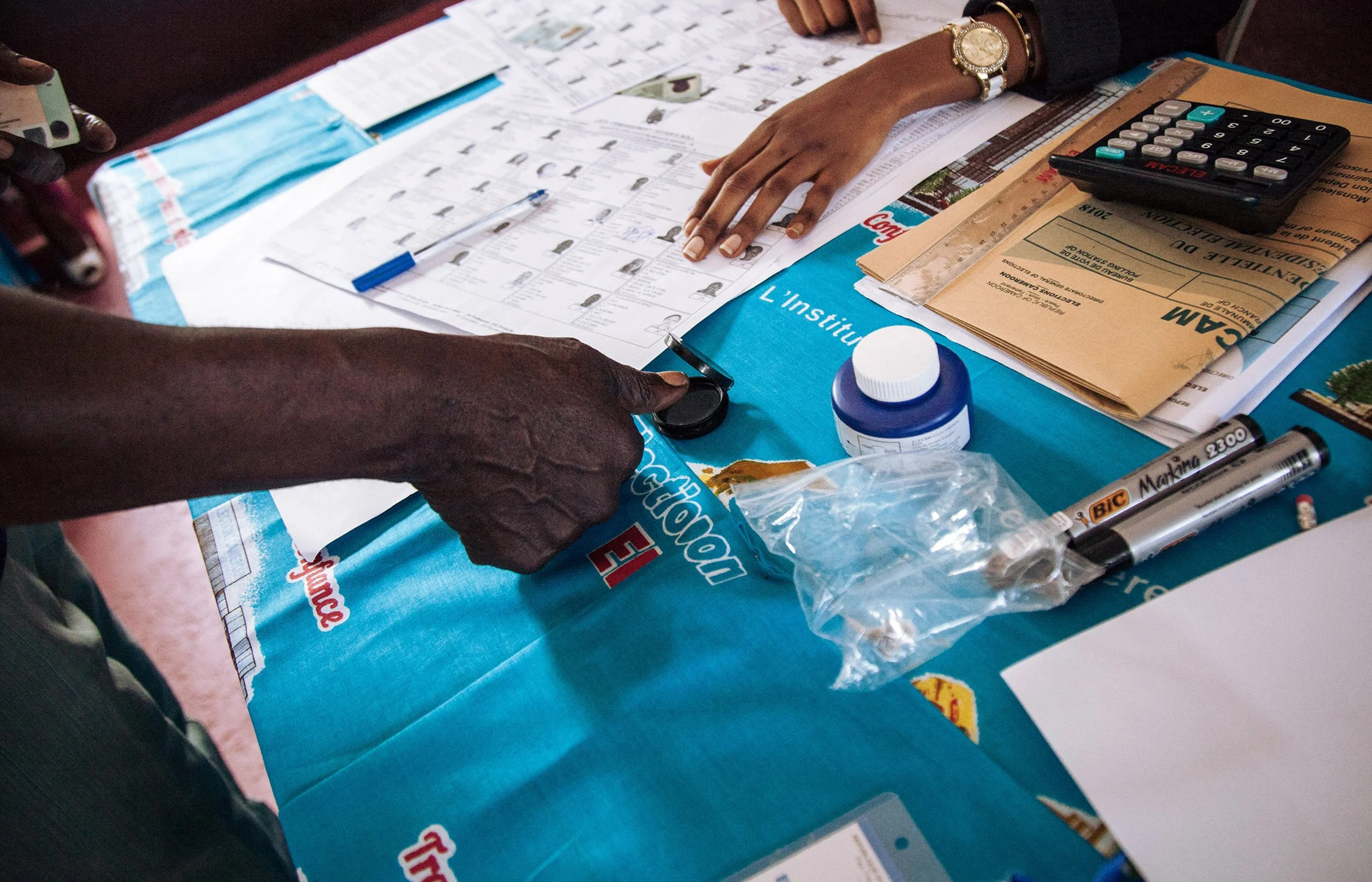
Besides the existence of well-defined legal frameworks, there exists an electoral management body – Elections Cameroon (ELECAM) that is responsible for organizing and managing the electoral process and referenda in Cameroon. As witnessed in several other countries, the electoral management body is faced with a serious problem of credibility and independence of its operations owing to the fact that, all members of the board and directorate are appointed by the president of the republic, head of the executive branch of government in contradiction of the fundamental principle of separation of powers. This explains why the institution faces many criticisms for repeatedly thwarting the electoral process in favor of the incumbent, thereby supporting the famous adage, “you cannot bite the hands that feed you.” While the institution has several obligations throughout the electoral process, contemporarily, with the upcoming 2025 presidential elections, ELECAM has failed to fulfill certain responsibilities. For example, the non-publication of the annual electoral register for the year 2024 in contradiction of Section 80 of the electoral code, which demands that there should be an annual publication of the register by 30 December.
Secondly, the aspect of voter eligibility in Cameroon does not conform to international standards. Every Cameroonian aged 20 years and above is eligible to register and vote. This silences the voices of a great number of the youth population between the ages of 15 and 19 years. Fairly, it should be expected of the sidelined active youth population to take part in the governance of their country, as enshrined in the International Covenant on Civil and Political Rights (ICCPR) [5], which Cameroon has duly ratified [6]. Ironically, youths between these ages are entrusted with guns as soldiers to defend the fatherland, but are not entrusted to participate in the governance and decision-making on matters of the state.
Furthermore, the number of registered voters remain at an all-time low level compared to the eligible voting population of the country. Part of the reasons that account for this could be attributed to the lack of national identity cards, ID cards which are prerequisite to getting registered on the electoral lists. Cameroonians, for years, have suffered exclusion from the electoral process due to delays in the production of ID cards. These further affect the decisions of the polls and impede the possibilities of change in government.
Another relevant actor in the electoral process is the Constitutional Council which is responsible for reviewing, validating, or disqualifying of candidates for presidential and parliamentary elections, and also to proclaim the result, handle post-election disputes, and issue final verdicts. Unfortunately, all members of the council are again appointed by the president of the republic, an active member and president of the leading political party. In fact, some members of this judicial body are equally militants of the CPDM party. Just like the appointment of ELECAM members, the constitutional council appointment has been a reward to loyalists of President Biya and the CPDM. This further strengthens the party’s control of the electoral process through these institutions that do everything to maintain their “master” in power.
The electoral campaigns, which is by de jury stated for 15 days before election day have proven to be insufficient for candidates to effectively carry out a campaign that will ensure all citizens understand their manifestos and get to know all candidates, especially new candidates and other opposition parties that lack national representation and presence at grassroot level. As such, this law is perceived as a targeted strategy to favor the incumbent who is highly represented in every subdivision of the country.
Finally, the secrecy of the ballot has been compromised in several elections in Cameroon, where voters have been harassed to vote for particular candidates meanwhile cameras have been planted in some polling stations. This defeats the confidentiality of voting and the credibility of the entire process. “The 15-day timeline” after the elections, when the Constitutional Council has to proclaim the result has been marked as an unnecessarily long and targeted attempt to pave room for unknown “gymnastics” away from the eyes of voters. This explains why in Cameroon, results are often disputed due to the inconsistency between the declared results by the constitutional council and the results gathered from polling stations on voting day.
- Key Threats to Peace and Security
Political instability and civil unrest: An entrenched electoral autocracy characterises Cameroon’s political system that undermines values of democratic governance, [7] enables civil unrest, and threatens national and regional peace and security. The government’s excessive use of force as a response to demonstrations, protests, and criticism, including internet shutdown, arbitrary arrests and detention, and forceful crackdowns on protesters [8], has worsened public anger and further justifies the legitimacy crisis. The lack of genuine opposition in government has led to more disenchantment amongst citizens, causing some citizens to seek other (more radical) ways of resistance, which more often result in violent confrontations.
Armed conflict and separatist movements: Under the current regime led by President Paul Biya, who has ruled the country since 1982, the electoral process has been systematically hijacked to preserve autocratic rule [9]. This has resulted in weakened governance structures, political instability, and intensified ongoing conflicts, mainly in the English-speaking regions of the country. Worthy of note is the fact that, the Anglophone crisis in Cameroon is greatly influenced by electoral autocracy [10]. The government’s failure to implement political reforms addressing the concerns of the Anglophone minority has fuelled resentment and given rise to armed separatist groups advocating for the independence of “Ambazonia”. The continuous fighting between combatants has led to mass displacements, with thousands of IDPs having moved to the French-speaking regions of the country [11] and thousands of refugees settled in Nigeria, grave human rights abuses and violations are recorded, thousands of deaths, which further protract the humanitarian crisis.
Erosion of democratic institutions and governance failure: Electoral autocracy has further destabilized the credibility of state institutions, particularly within key institutions like the legislature, judiciary, and election management body, all of which are mostly influenced by the executive arm of the state [12]. There is frequent misappropriation of state funds, aggravating economic inequalities and further enhancing grievances against the state, and citizens’ lack of trust in state institutions. State legitimacy has been weakened by the lack of transparency and accountability, causing resentment among citizens against the state and further leading to social division and instability.
Policy Recommendations
In terms of electoral reforms, it is more than essential for the government of Cameroon to restructure the elections management body – ELECAM, to ensure it operates in full autonomy, guaranteeing transparency and credibility. More specific action points from the electoral management body could be to:
- Ensure publication of results from all polling stations immediately after vote counting.
- Enhancing inclusivity by reviewing the eligible voting age from 20 years to 18 years could boost credibility of the electoral process and enhance civic responsibility.
- Extending the campaign period from 15 days to 30 days before elections could offer level playground for parties to effectively communicate to the entire population, mindful of demographics and geographic locations.
- Strict penalties for electoral misconduct, like stuffing ballot boxes, vote rigging, voter suppression, and intimidation of other stakeholders, including the opposition and the media could be imposed on actors.
In terms of strengthening democratic institutions, the state needs to ensure judicial independence by depoliticizing the judiciary and appointing judges on merit, rather than on political considerations. The legislature needs to be reformed to give greater representation to opposition parties and marginalized groups for an equitable political system. Civil society groups could be empowered as watchdogs and monitors of public action to keep the government accountable, promote transparency, and advocate for democratic change.
To enhance peace and security, it is indispensable for the state to initiate an all-inclusive dialogue with stakeholders of the Anglophone crisis to negotiate a peaceful resolution to the crisis. There is urgent need for constitutional amendments that provide greater autonomy to regional authorities, which will address problems of political marginalization in the long term.
International bodies—the United Nations and the African Union need to enhance their diplomatic engagement with Cameroon to advocate for reforms that promote and protect democracy and conflict resolution efforts. The international community could provide financial and technical aid for capacity-building programs that will enhance democracy and an enabling environment for truth and reconciliation to resolve persisting conflicts and restore peace.

Enowbachem Agbortanyi
Enowbachem Agbortanyi is a Policy Analyst with the Peace and Security Division at the Nkafu Policy Institute. He holds a Master’s in Political Science from the University of Gothenburg and is a Swedish Institute Alumnus. His work spans roles at Centre for Human Rights and Democracy in Africa (CHRDA), and research contributions to the Varieties of Democracy Institute (V-Dem) and the Governance and Local Development Institute (GLD) both in Sweden.