By Enowbachem Agbortanyi, Policy Analyst
A Symbolic Shift Within Structural Continuity
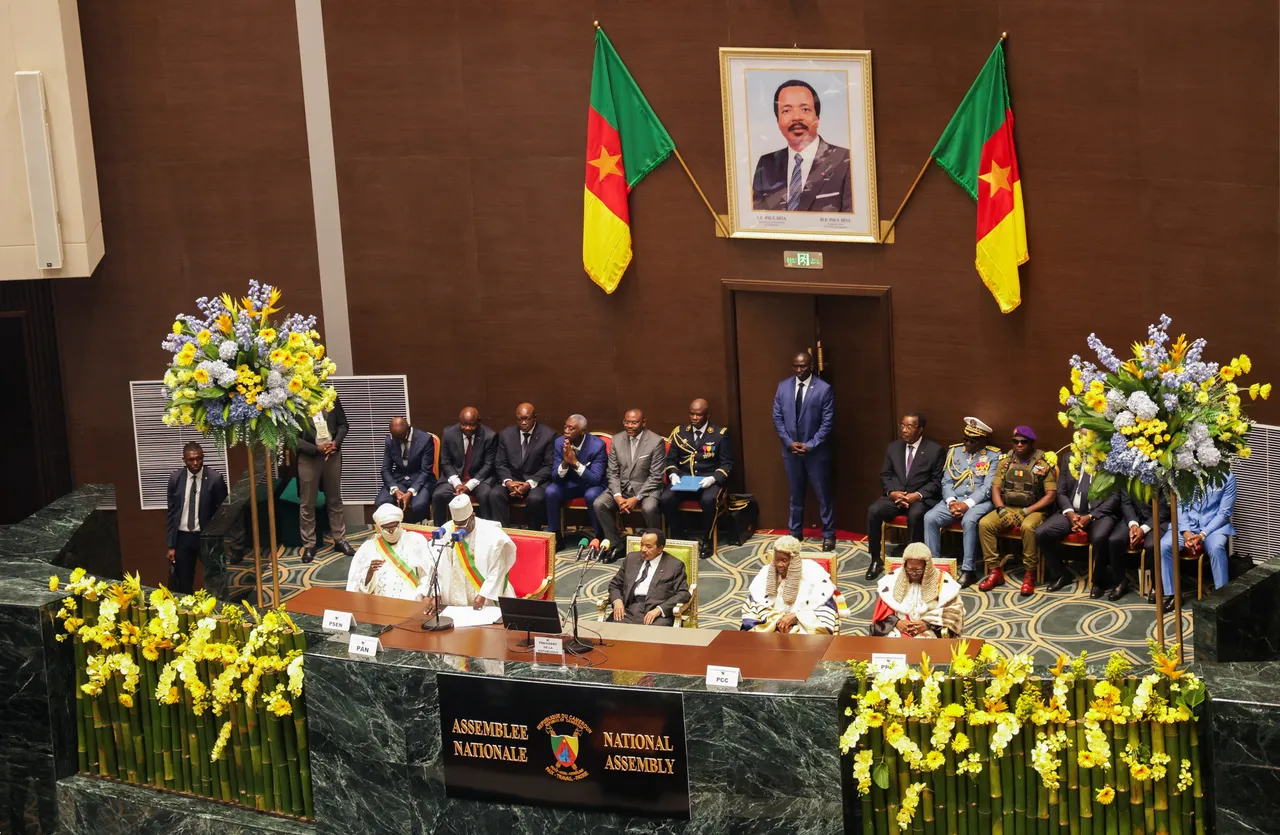
The legislative branch in Cameroon has reached a significant period of transformation with new leadership in both houses of Parliament. The election of the Right Honourable, Théodore Datouo as the new Speaker of the National Assembly, bringing to an end the 34-year rule by Cavaye Yeguié Djibril, is arguably the most significant change in the leadership of the lower chamber since the reintroduction of multiparty politics in the early 1990s. The Senate has not been left behind in this wave of change, with Sen. Aboubakary Abdoulaye taking over as President of the Senate. These changes are seen by many as a “generational shift” in Cameroon’s legislative leadership, but one that has been achieved within the ruling party’s domain. The implications of Hon. Cavaye Yeguié Djibril’s departure should therefore not be underestimated, especially in a political system that is largely characterized by continuity, with President Biya having been in power since 1982.
However, a deeper analysis reveals that this is not the case. Right Hon. Datouo is not an outsider but rather an insider, as an active member of the ruling Cameroon People’s Democratic Movement (CPDM), having been Vice President of the Assembly, and having been involved in efforts at modernization, including overseeing the construction of a new complex for parliament. The implications of this cannot be overstated because this is not a change within a party but rather a change within the same structure.
In addition, the general political circumstances also support this argument. The legislative elections, which were originally supposed to be held earlier, have been rescheduled by extending the current mandate of parliamentarians to December 2026. This further cements the executive’s hold over the political calendar. Even within the National Assembly Bureau, the opposition’s representation is limited, again reflecting the preponderant role of the ruling party.
In this light, the leadership transition should be viewed not as democratization, but rather as elite replacement or renewal. This is an adaptive strategy for regime stability in the face of both internal and external drivers of change. This should be viewed as part of a larger trend of leadership circulation in hybrid regimes without systemic transformation.
Policy Expectations: Gradual change or maintenance of institutional status quo?
The question that arises now is whether this change in leadership will be accompanied by significant policy shifts or simply consolidate existing patterns of governance. Three areas are particularly noteworthy: legislative assertiveness, economic governance, and political reform.
- Legislative assertiveness and oversight
A major, though measured, hope is that some degree of improvement in the activism of Parliament is possible. The National Assembly, under the leadership of Hon. Djibril, was often described as a ‘rubber stamp’ Parliament, with little ability to check the executive branch of government. The possibility of a new Speaker may, in theory, create an opportunity for some procedural reforms, as well as some checking of the executive’s policies. Nevertheless, the structural barriers are considerable, especially with the CPDM occupying the majority 152 of the 180 seats at the National Assembly.
- Economic policy priorities and developmental framing
Right Hon. Datouo’s profile as one associated with infrastructure and institutional modernization could indicate the new emphasis on developmental legislation. The country still faces economic challenges such as unemployment, infrastructure development, and the delivery of public services.
In this case, the new leadership could focus on laws such as the efficiency of public investment, industrial policies, and import substitution strategies—an agenda already advocated by the CPDM government.
The legislative agenda could therefore mirror the existing government agenda with very few new paradigms. However, the absence of effective oversight mechanisms could mean that the output of the policies remains on the production of legislative output as opposed to developmental output.
- Political reform and electoral governance
The area of change that is perhaps most significant, yet least likely, is that of political reform. The recent electoral cycle, including the disputed presidential election of 2025 and delays in legislative elections, has sparked debate about the credibility of elections and democracy.
In theory, a new leadership of the legislature could drive reform of the electoral code, improve the role of independent institutions, or increase transparency in politics. In practice, this would demand political will from the executive and party leadership, which has traditionally been focused on stability rather than reform.
Conclusion: managed change in a constrained system
The change of leadership in Cameroon’s legislative body marks an important moment in politics, but it does not necessarily mark a transformative moment. Rather, it is part of a broader pattern of adaptive change in a system marked by executive dominance, party institutionalization, and a lack of institutional autonomy.
The lesson for policymakers and scholars is that change in Cameroon is likely to be gradual, negotiated, and elite-led. The new leadership in the legislative body might usher in changes in terms of style, such as greater efficiency, a better image, or policy activism, but it is unlikely to fundamentally alter the underlying patterns of governance.
Ultimately, the significance of this moment in Cameroon politics will depend not on the individuals but on whether it opens up space, however small, for a more responsive, accountable, and development-oriented system of governance. It marks evolution without rupture, a recalibration rather than a redistribution of power.

Enowbachem Agbortanyi
Enowbachem Agbortanyi is a Policy Analyst with the Peace and Security Division at the Nkafu Policy Institute. He holds a Master’s in Political Science from the University of Gothenburg and is a Swedish Institute Alumnus. His work spans roles at Centre for Human Rights and Democracy in Africa (CHRDA), and research contributions to the Varieties of Democracy Institute (V-Dem) and the Governance and Local Development Institute (GLD) both in Sweden.