
Introduction
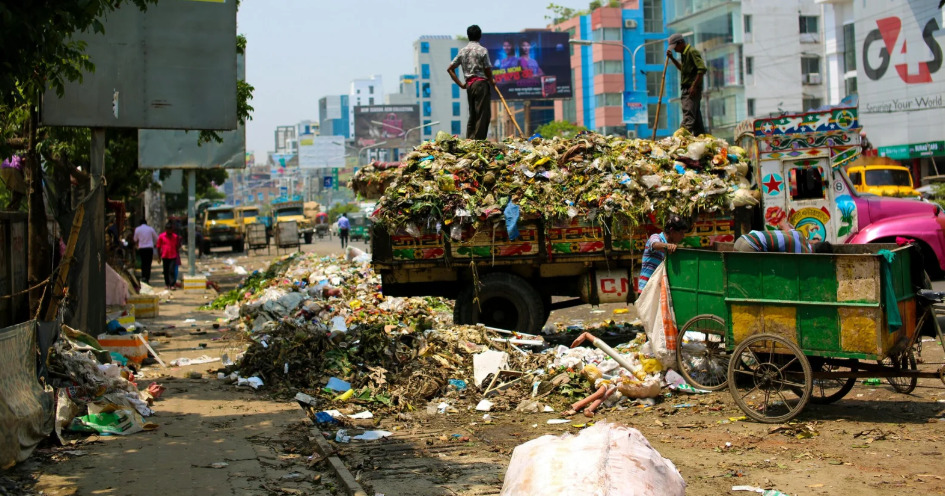
In early 2025, Cameroonians on social media made humour of urban waste by posting photos of themselves on garbage heaps. Their online activism drew attention to the nuisance of urban waste, with an underlying message that the uncollected garbage endangered the health of the population. The activists stated that waste has become an obstacle to the well-being of the population (1). Scattered haphazardly across streets, near homes, markets, businesses, healthcare facilities, and other public services, waste causes disease, odors, and pollution that impact people’s daily lives (2). The government’s response to this situation is worryingly timid. It appears that the relevant authorities seem powerless to address the scale of the problem. Furthermore, waste management infrastructure is slow to be established, while collection and treatment services are not functioning optimally. However, given its impact on the environment and people’s lives, waste has been placed on the civil society agenda (3).
In addition to the limited actions of the government, civil society is organizing to propose effective alternatives for urban waste management in Cameroon. Although considered a vague category, civil society refers to all groups, actors, and institutions that organize and operate outside the state and/or intend to remain outside the sphere of political competition. It refers, in particular, to the nonprofit sector, but also to community organizations, NGOs, religious organizations, professional and intellectual organizations, as well as economic firms and the media (4). Through these groups, populations participate in the management of problems that concern them. This includes waste, considered as any residue from a production, transformation, or use process; any substance or material produced; or, more generally, any movable or immovable property abandoned or destined for abandonment.
Upon closer inspection, members of civil society are responsible for a substantial amount of urban waste. As part of the problem, they can be of invaluable assistance in the search for solutions. It is with this in mind that the Minister of Housing and Urban Development stated in the press release launching the General Assembly on Waste that these meetings aim to “formulate sustainable solutions within the framework of a participatory and inclusive approach that will encourage everyone’s support in their implementation.” (5) This raises the following question: What role can civil society play in waste management in Cameroon?
This question has the merit of highlighting the role civil society must play in public waste management policies. It is important to analyze civil society’s interventions (I) before emphasizing the need for concerted action with public authorities (II).
- Civil Society’s Urban Waste Management Initiatives
Cameroon faces the challenge of an inefficient waste management system, with heaps of garbage piled up on the street corners and in unused plots of land (6). This development occurs within a context where the state expects assistance from the civil society. On the one hand, the state does not hesitate to be ‘helped’ and, on the other hand, the CSOs see themselves as stakeholders in urban waste management primarily because the waste – the stench, water pollution, filthy environment, and disease – directly affects members of the society. Civil society organizations are closer to the people and from this standpoint, they observe urban waste and can thus more easily intervene in its management as experts.
In this regard, in the face of challenges of waste disposal and collection (7, 8), CSOs have emerged as important actors, intervening to educate and raise public awareness, lending support to public-private partnerships (PPP), as well as influencing waste management policies. The interventions on awareness and education usually focus on the importance of recycling waste, which could also involve training people on how to recycle the waste (9, 10). CSOs also educate people about the health hazards of waste: some non-governmental organizations are recycling e-waste in Cameroon, thus preventing some of the harmful waste from getting into the environment. They also raise awareness on harmful e-waste. Most importantly, they collect, repair, and sell some of the recycled electronic and electrical appliances recovered from waste (10).
The extent to which individuals, private businesses, and NGOs target plastic waste in Cameroon makes it look like the civil society is comparatively more active in this type of waste management. A glaring example of such activity is the regular campaigns by the civil society to pick up plastic along the coastline of Limbe (11). Furthermore, the story of ‘plastic man’, a young Cameroonian who recycles plastic waste in Douala, caught world attention a few years ago (12). Meanwhile, the CSO involved in plastic recycling contribute to the overall 20% of Cameroon’s recycled plastics. The country produces 600.000 tonnes of plastic annually, that is, 10% of all national garbage (ibid).
CSOs’ contribution to waste collection, recycling, and disposal has led to the Cameroon government collaborating with this sector as partners in waste management (13). As demonstrated in instances where NGOs recycle e-waste and plastics, one can conclude that CSOs play instrumental roles in identifying opportunities in waste management. They also finance and provide logistics on the management of waste.
Despite these efforts by CSOs, more concerted effort is needed to manage urban waste in Cameroon, as discussed in the next section.
II- The need for concerted action with public authorities in urban waste management
Generally, public authorities intervene upstream to define waste management policies, while civil society organizations act at the implementation stage. This approach is ineffective, as policies defined from the top can be out of step with reality. Since civil society is close to the problem at hand, it seems appropriate to involve it in all phases of the design and implementation of waste management policies.
First, civil society provides significant support in the design of waste management policies. To this end, it should be given the opportunity to share with public authorities its findings and experiences on the scope of the waste problem, as well as the techniques it considers optimal on the ground. Thus, dialogue forums such as the National Forum on Waste represent a first step, which must be supplemented by working committees tasked with designing regulations and decision-making bodies for waste management. Civil society representatives must, if they do not sit on these decision-making bodies, be consulted in advance by the relevant administrations.
Second, civil society must be expressly delegated by public authorities to ensure waste management on the ground. To this end, local authorities must initiate collaboration with civil society actors carrying out certain sanitation projects in neighborhoods. They must grant these organizations an agreement in principle to allow them to work freely within their constituencies. This agreement is useful in that it will allow them to gain public support for waste management activities. This may involve the pre-collection of household waste, cleaning gutters, waste disposal, land clearing, etc., with the objective of strengthening the actions undertaken by municipalities in this area. To carry out these actions, a municipality must necessarily propose a collaboration contract, defining the tasks to be performed on the ground for each organization. This municipal-civil society partnership must be adequately regulated by legal texts.
Third, concerted action seems necessary to compensate for the lack of financial and logistical resources that hinder the deployment of civil society organizations. Through the flexibility that characterizes their operations, civil society organizations can avoid the delays and misappropriations to which funds intended for waste management are prone. Through a contractual approach, they must account for the use of the resources made available to them.
Conclusion and Recommendations
Civil society is playing a crucial role in managing waste in Cameroon and they can still do much more in a context where the state needs assistance in waste management. CSOs collect and recycle waste, educate the population, and form partnerships with the public sector to ensure proper waste management. Lapses occur, however, when authorities do not involve the civil society organizations in all phases of design and waste management policies. Additionally, it is necessary for civil society organizations to have a legal binding text showing that they work within a particular constituency. Furthermore, to reduce air, food and water pollution, the state could empower CSOs to invest in more organized trash management such as proper sorting of solid, organic, and electronic wastes.

Prof. Théophile NGUIMFACK VOUFO
Holder of a PhD/Ph.D in Public Law, option Public Finance, Dr. Nguimfack is currently Lecturer at the Faculty of Legal and Political Sciences of the University of Dschang.

Dr. Primus M. Tazanu
Dr Primus M. Tazanu is a Research Fellow in Governance at the Nkafu Policy Institute .He is equally a lecturer at the Department of Sociology and Anthropology, University of Buea, Cameroon. Primus holds a PhD in social anthropology from the University of Freiburg, Germany